Purple and supersweet: breaking the linkage
Some breeding goals begin with a combination that nature rarely hands over. Purple colour and supersweet kernels are one of them.
The recessive sh2 allele reduces starch formation, helping kernels retain more sugar at eating stage. Functional A1 is part of the anthocyanin pathway. It supports pigmentation, but other genes and the tissue in which they act also determine the colour. [1, 3]
The two loci lie close together on chromosome 3. In relevant starting material, sh2 is linked to non-functional a1, while functional A1 accompanies Sh2. Recombination between them can produce the desired A1–sh2 combination. Breaking the linkage means reshuffling alleles, not disabling A1. [1, 2]
One chromosome segment per line; not to scale. Other colour genes are not shown. This is a breeding concept, not a genotype report for PROTISEM material.
A new combination is the beginning.
Published research has demonstrated that purple pigmentation and sh2 supersweetness can be combined. It is a breeding possibility, not a shortcut to a finished variety. [1]
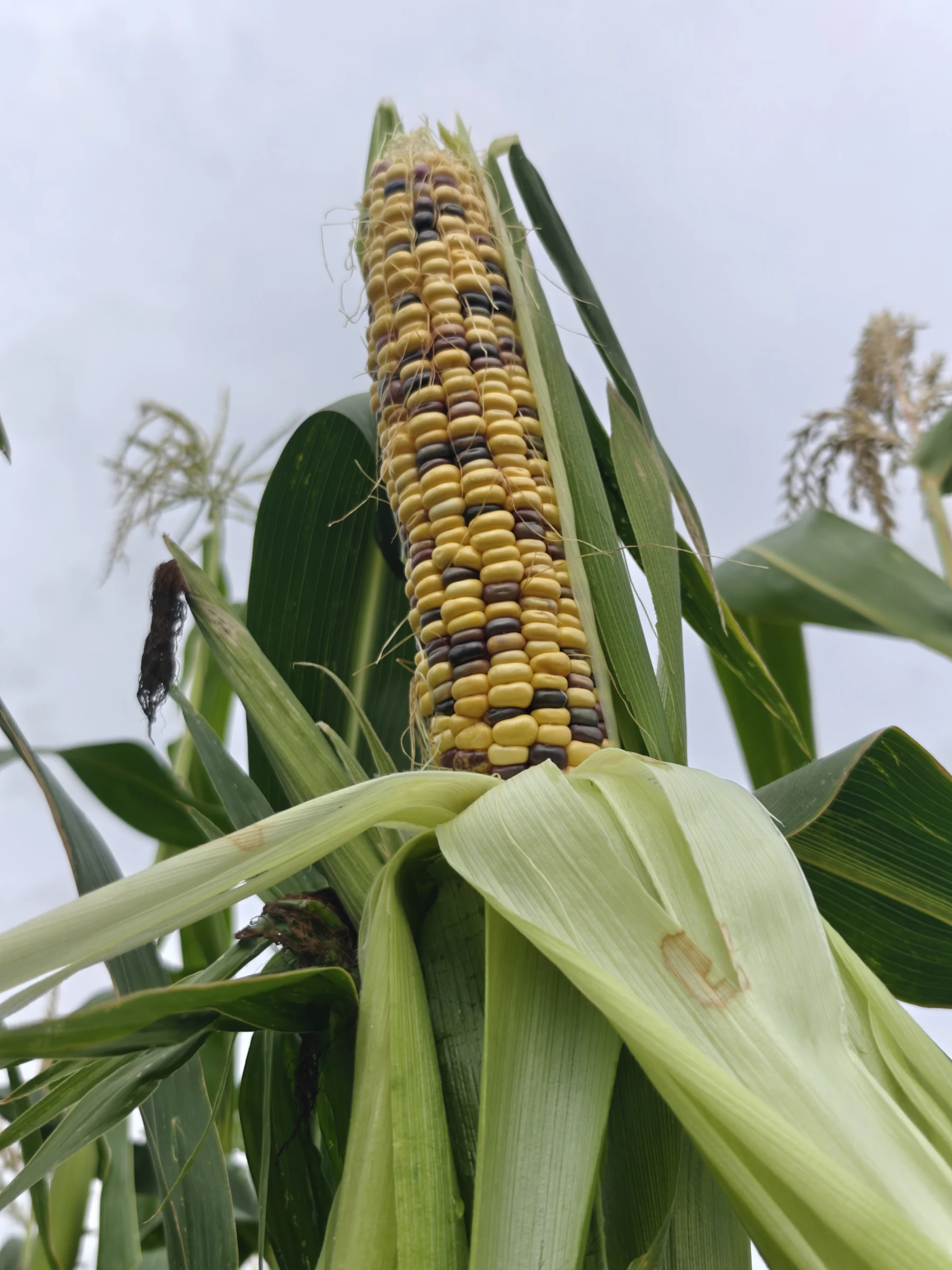
At PROTISEM, the 2026 harvest yielded first candidate recombinants with purple kernels in a supersweet background. The next step is progeny testing. A photograph alone cannot establish the A1–sh2 haplotype or show that a combination breeds true.
Our goal remains a useful fresh-market ear for Northwest Europe. Colour has to be carried by a plant that performs: with tip fill, protective green husks and the quality a buyer expects. The genetic combination opens a door. Selection has to take it into the field.